“The category is Bey.”
This line from Beyoncé Knowles-Carter’s SUMMER RENAISSANCE proves a point: time and time again, Knowles-Carter, known solely as Beyoncé, has proved herself to be an artist that defies categorization. As a musician whose work spans decades, genres, and musical styles, Beyoncé has continuously redefined the parameters of success, leaving a lasting imprint on the fabric of culture.

From her early days as a member of Destiny’s Child to her chart-topping solo ventures, she has consistently pushed artistic boundaries and shattered records. Beyoncé holds over 20 Guinness World Records, including the highest amount of GRAMMY Awards and BET Awards wins. Her recent Renaissance World Tour surpassed acts like Michael Jackson and The Weeknd for the highest-grossing tour for a Black artist.
Beyoncé is credited with the creation of several modern music industry standards, including the visual album, the surprise release, and the digital drop. Peter Robinson of The Guardian described Beyoncé’s business strategy as “a masterclass in both exerting and relinquishing control.”
“As Beyoncé showed, controlling artistic output is vital in setting the agenda, and it’s possible to do this in such a way as to ensure that however much of a bang you make, music is audible above the noise,” he wrote.
In addition to surpassing the achievements of her peers, Beyoncé continually creates her own milestones through her extensive body of work. The singer has 9 studio albums, including COWBOY CARTER, her newest foray into country music, released March 29 of this year. Beyoncé’s other solo works: “Dangerously in Love,” “B’Day,” “I Am… Sasha Fierce,” “4,” “Beyoncé,” “Lemonade,” “The Lion King: The Gift,” and “RENAISSANCE,” respectively, encompass numerous genres and styles of music.
Beyoncé’s newest musical project is a three-album series intended to reclaim musical genres. The first album, RENAISSANCE, is a tribute to queer, Black dance music. The album contains references to drag balls and house culture across Chicago and New York City. The New Yorker’s Carrie Battan calls the album “a work of sonic hyper-specificity with an egalitarian spirit.”
“It’s a swaggering, high-octane record: Beyoncé seems to be holding defibrillator paddles, attempting to shock some life into a culture gone inert,” Battan wrote.
And RENAISSANCE isn’t done here. Beyoncé’s newest album, COWBOY CARTER, which is not included in this data, is a continuation of her artistic vision. The album reclaims the Black roots of country music while paying tribute to industry legends like Dolly Parton and Willie Nelson. Beyonce’s foray into this genre shows her progression as an artist — moving forward while understanding and using the past as a tool. Beyoncé herself addressed this during the release of her first album.
“This three-act project was recorded over three years during the pandemic,” she wrote in a message on her official website. “A time to be still, but also a time I found to be the most creative. Creating [Renaissance] allowed me a place to dream and to find escape during a scary time for the world. It allowed me to feel free and adventurous in a time when little else was moving.”
Methods:
This dataset presents a compilation of tracks from Beyoncé’s albums, accessible on Spotify. It spans the scope of Beyoncé’s artistic evolution, spanning diverse genres, influences, and musical expressions explored throughout her career through her musical catalog on Spotify. The data is acquired directly from the Spotify Web API, which provides information about tracks, artists, and albums through the streaming app.
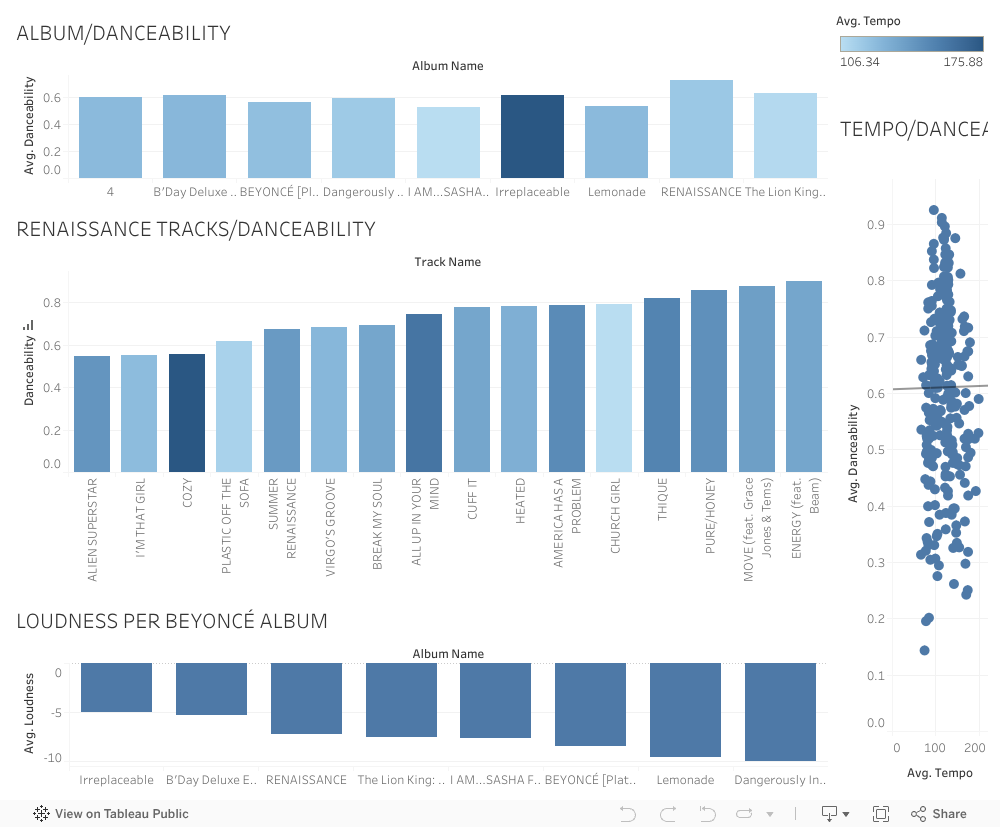
I focused on different aspects of Beyoncé’s music which are recognizable to an average listener. The first is “loudness,” which is an overall measure of each track by decibels, which provides a negative value. I cleaned the data by focusing only on Beyoncé’s eight solo studio albums, eliminating things like features, non-deluxe versions, remixes, and collaborations. I found the average loudness of each album and sorted them by volume. From the data, Beyoncé’s quietest album is “Irreplaceable,” which has an average loudness of -5.016 decibels per song. The loudest album is “Dangerously in Love,” which has an average loudness of -10.056 decibels per song — double the amount that “Irreplaceable” contains.
Another aspect that I focused on is “danceability,” which is “a measure from 0.0 to 1.0 indicating how suitable a track is for dancing based on a combination of musical elements,” according to the data description. I first found the average danceability of each studio album — unsurprisingly, RENAISSANCE came out on top. I also included tempo, or the speed of a song in beats per minute, in this chart, which is indicated by shade of blue. “Irreplaceable” has the highest average tempo of 175.88 beats per minute, while “I Am… Sasha Fierce” has the lowest average tempo of 106.34 beats per minute.
I then applied this same process to “RENAISSANCE,” the most danceable album, to analyze individual tracks. The track with the highest average danceability is “ENERGY (feat. Beam)” at .9030. The track with the lowest average danceability is “ALIEN SUPERSTAR” at .5450. The track with the highest average tempo is “COZY” at 149.15 BPM. The track with the lowest average tempo is “CHURCH GIRL” at 92.03.
I then wanted to find the correlation between tempo and danceability: Don’t high-tempo songs make people want to dance? From my findings — not really. The correlation between the two of them is negative, at -.2%. From my calculations, it is exactly -0.02643632744.
THE DATA: https://www.kaggle.com/datasets/yukawithdata/beyonce-track-attribute-data
 Clara McCourt